Articles
What this handout is about
When we use nouns in English, articles (a, an, and the) specify which and how
many nouns we mean. To choose the correct article for your sentence, you need to
answer two questions. First, do I mean this one exactly, one of many, or all of
them everywhere? Second, is the noun count or non-count? This handout explains
these questions and how their answers help determine which article to use.
Using this handout
As you use the
handout, try to keep three things in mind:
-
First, this
handout will be most effective if you use it as a tool. Every time you read
this handout, read it along side another piece of writing (a journal
article, a magazine, a web page, a novel, a text book, etc.). Locate a few
nouns in the reading, and use the handout to analyze the article usage. If
you practice a little bit at a time, this kind of analysis can help you
develop a natural sensitivity to this complex system.
-
Second, using
articles correctly is a skill that develops over time through lots of
reading, writing, speaking and listening. Think about the rules in this
handout, but also try to pay attention to how articles are being used in the
language around you. Simply paying attention can also help you develop a
natural sensitivity to this complex system.
-
Finally, although
using the wrong article may distract a reader’s attention, it usually does
not prevent the reader from understanding your meaning. So be patient with
yourself as you learn.
Basic rules
This is a simple list, but understanding it and remembering it is crucial to
using articles correctly.
Rule # 1: Every time
a noun is mentioned, the writer is referring to:
-
All of them everywhere (“generic” reference),
-
One of many, (“indefinite” reference) or
-
This one exactly (“definite” reference)
Rule # 2: Every kind
of reference has a choice of articles:
-
All of them everywhere…(Ø, a/an, the)
-
One of many……………..(Ø, a/an)
-
This one exactly…………(Ø, the)
(Ø = no article)
Rule # 3: The choice
of article depends upon the noun and the context. This will be explained more
fully below.
Basic questions
To choose the best
article, ask yourself these questions:
-
“What do I mean? Do I mean all of them everywhere, one of many, or this one
exactly?”
-
“What kind of noun is it? Is it countable or not? Is it singular or plural?
Does it have any special rules?”
Your answers to these questions will usually determine the correct article
choice, and the following sections will show you how.
When you mean “all of them everywhere”
Talking about “all of them everywhere” is also called “generic reference.” We
use it to make generalizations: to say something true of all the nouns in a
particular group, like an entire species of animal. When you mean “all of them
everywhere,” you have three article choices: Ø, a/an, the. The choice of article
depends on the noun. Ask yourself, “What kind of noun is it?”
Non-count nouns = no
article (Ø)
-
Temperature is measured in degrees.
-
Money makes the world go around.
Plural nouns = no
article (Ø)
-
Volcanoes are formed by pressure under the earth’s surface.
-
Quagga zebras were hunted to extinction.
Singular nouns = the
-
The computer is a marvelous invention.
-
The elephant lives in family groups.
Note: We use this form (the + singular) most often in technical and scientific
writing to generalize about classes of animals, body organs, plants, musical
instruments, and complex inventions. We do not use this form for simple
inanimate objects, like books or coat racks. For these objects, use (Ø +
plural).
Singular nouns = a/an
when a single example represents the entire group
-
A rose by any other name would still smell as sweet.
-
A doctor is a highly educated person. Generally speaking, a doctor also has
tremendous earning potential.
How do you know it’s generic? The “all…everywhere” test
Here’s a simple test you can use to identify generic references while you’re
reading. To use this test, substitute “all [plural noun] everywhere” for the
noun phrase. If the statement is still true, it’s probably a generic reference. Example:
-
A whale protects its young—”All whales everywhere” protect their young.
(true—generic reference)
-
A whale is grounded on the beach—”All whales everywhere” are grounded on the
beach. (not true, so this is not a generic reference; this “a” refers to
“one of many”)
You’ll probably find generic references most often in the introduction and
conclusion sections and at the beginning of a paragraph that introduces a new
topic.
When you mean “one of many”
Talking about “one of many” is also called “indefinite reference.” We use it
when the noun’s exact identity is unknown to one of the participants: the
reader, the writer, or both. Sometimes it’s not possible for the reader or the
writer to identify the noun exactly; sometimes it’s not important. In either
case, the noun is just “one of many.” It’s “indefinite.” When you mean “one of
many,” you have two article choices: Ø, a/an. The choice of article depends on
the noun. Ask yourself, “What kind of noun is it?”
Non-count nouns = no
article (Ø)
-
Our science class mixed boric acid with water today.
-
We serve bread and water on weekends.
Plural nouns = no
article (Ø)
-
We’re happy when people bring cookies!
-
We need volunteers to help with community events.
Singular nouns = a/an
-
Bring an umbrella if it looks like rain.
-
You’ll need a visa to stay for more than ninety days.
Note: We use many different expressions for an indefinite quantity of plural or
non-count nouns. Words like “some,” “several,” and “many” use no article (e.g.,
We need some volunteers to help this afternoon. We really need several people at
3:00.) One exception: “a few” + plural noun (We need a few people at 3:00.) In
certain situations, we always use “a” or “an.” These
situations include:
-
Referring to something that is one of a number of possible things. Example:
My lab is planning to purchase a new microscope. (Have you chosen one yet?
No, we’re still looking at a number of different models.)
-
Referring to one specific part of a larger quantity. Example: Can I have a
bowl of cereal and a slice of toast? (Don’t you want the whole box of cereal
and the whole loaf of bread? No, thanks. Just a bowl and a slice will be
fine.)
-
With certain indefinite quantifiers. Example: We met a lot of interesting
people last night. (You can also say “a bunch of” or “a ton of” when you
want to be vague about the exact quantity. Note that these expressions are
all phrases: a + quantifier + of.)
-
Exception: “A few of” does not fit this category. See Number 8 in the next
section for the correct usage of this expression.
-
Specifying information associated with each item of a grouping. Example: My
attorney asked for $200 an hour, but I’ll offer him $200 a week instead. (In
this case, “a” can substitute for the word “per.”)
-
Introducing a noun to the reader for the first time (also called “first
mention”). Use “the” for each subsequent reference to that noun if you mean
“this one exactly.” Example: I presented a paper last month, and my advisor
wants me to turn the paper into an article. If I can get the article written
this semester, I can take a break after that! I really need a break!
Note: The writer does not change from “a break” to “the break” with the second
mention because she is not referring to one break in particular (“this break
exactly”). It’s indefinite—any break will be fine!!
When you mean “this one exactly”
Talking about “this one exactly” is also called “definite reference.” We use it
when both the reader and the writer can identify the exact noun that is being
referred to. When you mean “this one exactly,” you have two article choices: Ø,
the. The choice of article depends on the noun and on the context. Ask yourself,
“What kind of noun is it?”
(Most) Proper nouns =
no article (Ø)
-
My research will be conducted in Luxembourg.
-
Dr. Homer inspired my interest in Ontario.
Note: Some proper nouns do require “the.” See the special notes on nouns below.
Non-count nouns = the
-
Step two: mix the water with the boric acid.
-
The laughter of my children is contagious.
Plural nouns = the
-
We recruited the nurses from General Hospital.
-
The projects described in your proposal will be fully funded.
Singular nouns = the
-
Bring the umbrella in my closet if it looks like rain.
-
Did you get the visa you applied for?
In certain situations, we always use “the” because the noun or the context makes
it clear that we’re talking about “this one exactly.” The context might include
the words surrounding the noun or the context of knowledge that people share. Examples
of these situations include:
Unique nouns
-
The earth rotates around the sun.
-
The future looks bright!
Shared knowledge
(both participants know what’s being referred to, so it’s not necessary to
specify with any more details)
-
The boss just asked about the report.
-
Meet me in the parking lot after the show.
Second mention (with
explicit first mention)
-
I found a good handout on English articles. The handout is available online.
-
You can get a giant ice cream cone downtown. If you can eat the cone in five
seconds, you get another one free.
Second mention (with
implied first mention—this one is very, very common)
-
Dr. Frankenstein performed a complicated surgery. He said the patient is
recovering nicely. (“The patient” is implied by “surgery”—every surgery has
a patient.)
-
My new shredder works fabulously! The paper is completely destroyed. (Again,
“the paper” is implied by “shredder.”)
Ordinals and
superlatives (first, next, primary, most, best, least, etc.)
-
The first man to set foot on the moon…
-
The greatest advances in medicine…
Specifiers (sole,
only, principle, etc.)
-
The sole purpose of our organization is…
-
The only fact we need to consider is…
Restricters (words,
phrases, or clauses that restrict the noun to one definite meaning)
-
Study the chapter on osmosis for the test tomorrow.
-
Also study the notes you took at the lecture that Dr. Science gave
yesterday.
Plural nouns in
partitive -of phrases (phrases that indicate parts of a larger whole) (Note:
Treat “of the” as a chunk in these phrases—both words in or both words out)
-
Most of the international students have met their advisors, but a few of
them have appointments next week. (emphasis on part of the group, and more
definite reference to a specific group of international students, like the
international students at UNC)
-
Most international students take advantage of academic advising during their
college careers. (emphasis on the group as a whole, and more generic
reference to international students everywhere)
-
Several of the risk factors should be considered carefully, but the others
are only minor concerns. (emphasis on part of the group)
-
Several risk factors need to be considered carefully before we proceed with
the project. (emphasis on the group as a whole)
-
A few of the examples were hard to understand, but the others were very
clear. (emphasis on part of the group)
-
A few examples may help illustrate the situation clearly. (emphasis on the
group as a whole)
Note: “Few
examples” is different from “a few examples.” Compare:
-
The teacher gave a few good examples. (a = emphasizes the presence of good
examples)
-
The teacher gave few good examples. (no article = emphasizes the lack of
good examples)
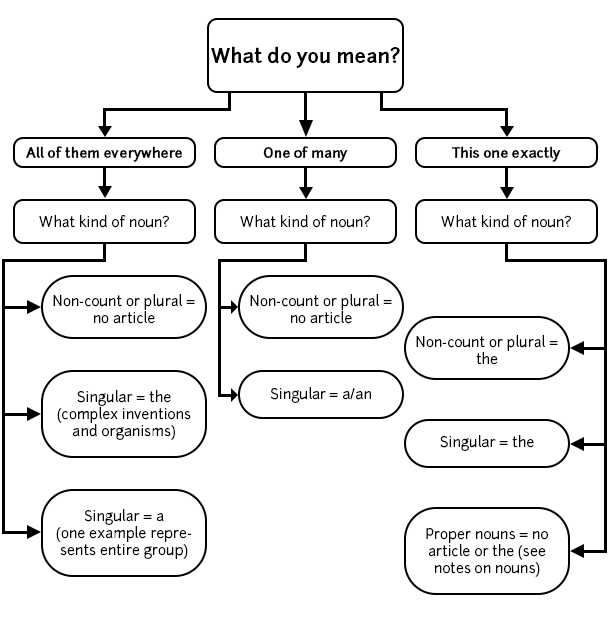
Article flowchart
For the more visually oriented, this flowchart sketches out the basic rules and
basic questions.
Some notes about nouns
Uncountable nouns
As the name suggests, uncountable nouns (also called non-count or mass nouns)
are things that can not be counted. They use no article for generic and
indefinite reference, and use “the” for definite reference. Uncountable
nouns fall into several categories:
-
Abstractions: laughter, information, beauty, love, work, knowledge
-
Fields of study: biology, medicine, history, civics, politics (some end in
-s but are non-count)
-
Recreational activities: football, camping, soccer, dancing (these words
often end in -ing)
-
Natural phenomena: weather, rain, sunshine, fog, snow (but events are
countable: a hurricane, a blizzard, a tornado)
-
Whole groups of similar/identical objects: furniture, luggage, food, money,
cash, clothes
-
Liquids, gases, solids, and minerals: water, air, gasoline, coffee, wood,
iron, lead, boric acid
-
Powders and granules: rice, sand, dust, calcium carbonate
-
Diseases: cancer, diabetes, schizophrenia (but traumas are countable: a
stroke, a heart attack, etc.)
Note: Different
languages might classify nouns differently
-
“Research” and “information” are good examples of nouns that are non-count
in American English but countable in other languages and other varieties of
English.
Strategy: Check a dictionary. A learner’s dictionary will indicate whether the
noun is countable or not. A regular dictionary will give a plural form if the
noun is countable. Note: Some nouns have both count and non-count meanings Some
nouns have both count and non-count meanings in everyday usage. Some non-count
nouns have count meanings only for specialists in a particular field who
consider distinct varieties of something that an average person would not
differentiate. Non-count meanings follow the rules for non-count nouns (generic
and indefinite reference: no article; definite: “the”); count meanings follow
the count rules (a/an for singular, no article for plural). Can you see the
difference between these examples?
-
John’s performance on all three exams was exceptional.
-
John’s performances of Shakespeare were exceptional.
-
To be well educated, you need good instruction.
-
To assemble a complicated machine, you need good instructions.
Proper nouns
Proper nouns (names of people, places, religions, languages, etc.) are always
definite. They take either “the” or no article. Use “the” for regions (like the
Arctic) and for a place that’s made up of a collection of smaller parts (like a
collection of islands, mountains, lakes, etc.). Examples:
-
Places (singular, no article): Lake Erie, Paris, Zimbabwe, Mount Rushmore
-
Places (collective, regional, “the”): the Great Lakes, the Middle East, the
Caribbean
Note: Proper
nouns in theory names may or may not take articles When a person’s name is part
of a theory, device, principle, law, etc., use “the” when the name does not have
a possessive apostrophe. Do not use “the” when the name has an apostrophe.
Examples:
|
the Doppler effect |
Einstein’s theory of relativity |
|
the Pareto index |
Murphy’s law |
|
the Reimann hypothesis |
Halley’s comet |
Note: Articles
change when proper nouns function as adjectives Notice how the article changes
with “Great Lakes” in the examples below. When place names are used as
adjectives, follow the article rule for the noun they are modifying. Examples:
I’m studying …
-
…the Great Lakes. (as noun)
-
…a Great Lakes shipwreck.(as adjective with “one of many” singular noun)
-
…the newest Great Lakes museum. (as adjective with “this one exactly”
singular noun)
-
…Great Lakes shipping policies. (as adjective with “one of many” plural
noun)
-
…Great Lakes history. (as adjective with “one of many” uncountable noun)
Works consulted
We consulted these works while writing this handout. This is not a comprehensive
list of resources on the handout’s topic, and we encourage you to do your own
research to find additional publications. Please do not use this list as a model
for the format of your own reference list, as it may not match the citation
style you are using. For guidance on formatting citations, please see the UNC
Libraries citation tutorial. We revise these tips periodically and welcome
feedback.
Byrd, Patricia, and Beverly Benson. 1993. Problem/Solution:
A Reference for ESL Writers. Boston: Heinle & Heinle.
Celce-Murcia, Marianne, and Diane Larsen-Freeman. 2015. The
Grammar Book: An ESL/EFL Teacher’s Course, 3rd ed. Boston: Heinle &
Heinle.
Swales, John, and Christine B. Feak. 2012. Academic
Writing for Graduate Students: Essential Tasks and Skills, 3rd ed. Ann
Arbor: University of Michigan Press.